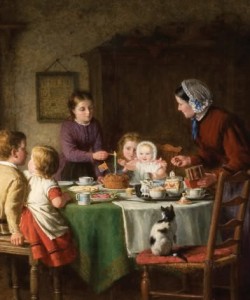
 Someone mentioned a couple of days ago that it was Lord John’s birthday. Possibly it was <g>, though I don’t recall ever specifying the date…
Still, let us take the opportunity to wish his Lordship many happy returns, even though his present state is perhaps not that happy…..
Excerpt from A BLESSING FOR A WARRIOR GOING OUT, Copyright © 2026 Diana Gabaldon
John Grey sat up abruptly, hearing the grate of the key in the lock. The door swung open and the big Polish seaman sidled in, bearing a tray.
“Has no one ever told you that you should knock before entering someone’s room?” John asked. “What if I had been engaged in something requiring privacy?”
He didn’t expect an answer, which was a good thing, as he didn’t get one. He had inveigled the Pole into telling him at least his first name, by dint of deliberately meeting the man’s eye every time the Pole appeared, touching his own chest and saying, “John,” very distinctly.
It had taken more than a week, but one day, the Pole set down his tray, tapped his own chest delicately, and gruffly said, “Mikolaj.” Then hurried out, not looking at John, but leaving him with a fleeting sense of exhilaration.
This had not led to any further exchange of confidences, though, and Mikolaj had reverted to his original face of stone when bringing in trays, removing chamber pots and escorting John on occasional strolls around the deck, the Pole carrying the iron ball attached to Grey’s ankle chain. While he appreciated the courtesy—if that’s what it was—it made him somewhat nervous, as he realized that should Mikolaj, whether by Richardson’s order or from simple pique, choose to toss the heavy ball overboard, Grey himself would inevitably follow it to the bottom of the sea.
For the moment, though, their interaction was limited to the placement of the tray on Grey’s small desk, and his customary thanks to the seaman. As he opened his mouth to utter this, though, he had a thought, and seizing the Pole’s sleeve to prevent his immediate departure, pointed to himself, saying, “John,” and at once at the Pole, saying, “Mikolaj.” Then to himself, “Thank you” and once more pointed at Mikolaj, eyebrows raised in question.
The Pole’s face went blank—well, slightly blanker than usual—for a moment. Then his lips pursed in thought, but after a moment, he nodded and said something that sounded like, “Jenkooyeh.”
“Jenkooyeh,” John said and bowed. The Pole gave him a short nod, turned and left.
Well, he supposed he could learn to speak Polish one word at a time. He wasn’t bloody doing anything else…
He glanced at the small stack of hand-written pages, placed criss-cross fashion to separate the documents:
A letter to William. Well, another letter to William. This was what, the fifth? Sixth?
Two sheets of fragmentary poetry—well, doggerel, at least, and he did wonder why it should be called that. He was fond of dogs, but had never detected any sense of whimsy, let alone any talent for rhyme in one.
A draft—another one—of his will. He was slightly hampered in the disposition of his property by not knowing exactly what it consisted of. He owned a small property in Philadelphia; he’d bought the house on Chestnut Street outright—but given the vagaries of war and government, had no idea whether he still owned it, or whether it had been appropriated by the Crown for the billeting of soldiers, or confiscated by the Continental Congress as the property of an enemy alien.
His house in Savannah was presumably still in British hands, but that was only rented.
He thought he had some share in a Cornish tin mine, but where it was, or of what his share consisted, he had no idea.
Why don’t I even know anything about my own affairs? He thought crossly.
You don’t know, because you don’t care.
“Well, not about houses,’ he said aloud. “Nor yet bloody tin mines.” He pushed the paper away and sat back in his chair. At his request, Miklolaj had had the port opened for light and air, and a brisk sea-breeze ruffled his hair and fluttered the papers on his table.
What do you care about?
“William,” he said, touching the small stack of pages. “Mother. Hal. Minnie and the boys.”
The thought of Hal’s sons conjured thoughts of Benjamin, and he felt a cramp in his gut. There was nothing whatever that he could do about it, though, and he forced his thoughts in a different direction.
“That bloody Scot,” he thought, and smiled, despite himself. And Claire, he added, to be fair.
“Oh, and Brianna, of course.” Thought of that redoubtable young woman made him smile again, and he picked up his quill and took a fresh sheet of paper.
“My Dear,” he wrote, “you will never suppose where I am—I would tell you, but I have no Idea, the Atlantic Ocean being a rather large Place. Finding myself with Time and to spare, I think I will amuse myself—and, perhaps, you—with the Tale of my recent Travails…”
His attempt to do this, though, met with difficulties. Being hit on the head and dragooned had the benefit of action, but the state of being kidnapped, considered solely for its dramatic effect, was rather… well, not boring, exactly, but far from entertaining.
He was further constrained by the knowledge that Richardson might read any of his papers whenever he chose, and it might therefore be less than prudent to tell Brianna Fraser MacKenzie what Richardson’s professed motives were, let alone his own opinion of the man.
Demented, and doesn’t wash often enough. That made him smile, though the description—had he written it—would have continued with “Bloody dangerous, though.”
Sighing, he put that letter aside for the moment and returned to the one to William.
“My dearest son…” To hell with Jamie Fraser, you’re my son as much—if not more—than his… “With luck, you will never receive this…” Idiot. If he doesn’t ever receive it, why should I apologise for sending it? But that’s not the point—if he does receive it, that should signal a sense of apology, shouldn’t it?
Oh, fncking hell…
Click to visit my official Book Ten webpage for information on A BLESSING FOR A WARRIOR GOING OUT, and to read many more excerpts from it.
NB: The painting is “Baby’s Birthday” by Frederick Daniel Hardy, 1867, courtesy of Wikimedia Commons.
This excerpt was also posted on my official Facebook page.
If you like, please leave a web comment below. Note that your comment will not appear immediately online, since all comments have to be moderated and approved by myself or my Webmistress. This may take a day or two so please check back.
All submitted web comments, including your name that you specify in the form, are public and can be seen by anyone on the World Wide Web. Please do not include any personal information that you don’t want to share with the world. Thanks!
Dear Diana,
Your books have brought me such joy through the years! I am both anxiously awaiting and dreading A Warrior Going Out, both to keep going with the many threads still hanging and to tie up loosened from previous books (such as Outlander’s unknown ghost/time traveler in the storm seen by Frank looking up at Claire brushing her hair- PLEASE DON’T FORGET TO EXPLAIN THAT!!, but also with fear of end of life scenarios, since it will be the last Outlander book.
OK, my real question of the day- can you explain your term “slip-jointed mule” from Outlander. Are you describing a “gaited” mule (who would move differently than a non-gaited mule, or just trying to describe a scrawny shambling mule who looked to real down at any minute? I have wondered about this every time I’ve heard it onthe audio book. Being a working artist, that is how I get to work and read (hear) your lovely books!
Thanks so much for the pictures you paint with words!
Eva
Bonjour
Juste pour vous dire que je suis tombée « accro » amoureuse des personnages tellement attachants malgré quelque s fois des scènes …. le moment de tranquillité pour avaler les épisodes était devenu comme une « drogue » à la série Outlander – Fin qu’on aurait pas voulu même si c’était écrit – on voudrait tellement vouloir modifier le temps et les choses dans la réalité, la fiction de cette série permet d’y rêver et si et si Jamy Fraser n’était pas mort … juste perdu ou devenu le fantôme , l’ange qui protégeait sa famille et qu’enfin il devenait visible pour Claire et plus … Malgré qu’il soit dit qu’il n’y aura pas de saison 9 peut être que …. Une suite pourrait s’écrire
Hâte Madame de vous lire et d’avoir une suite sur Netflix
Merci
Translation:
I just wanted to say that I’ve become completely hooked—in love—with these incredibly endearing characters, despite some of the scenes… Finding a quiet moment to binge-watch the episodes became like a “drug.” As for the ending—the one we didn’t want, even though it was already written—we so wish we could change time and reality; the fiction of this series lets us dream of “what if.” What if Jamie Fraser hadn’t died… but was just lost, or had become a ghost—an angel protecting his family—and finally became visible to Claire again? Even though they say there won’t be a Season 9, perhaps… a continuation could still be written.
I look forward to hearing from you and seeing a continuation on Netflix.
Thank you.
I have been in the habit of re-reading the entire series each time you release a new book, but with 9 gargantuan novels, and having read them often (though I will likely read them again) I am trying to wait patiently for the 10th.
Thank you for gifting us with witty dialogue, intelligent vocabulary (sometimes I even have to look up a word!), and crafty construction. Mostly, though, thanks for the enduring love story and never giving up on hope.
Warmly,
Julia
My daughter introduced me to your writing 20 years ago, that she was reading this was so amazing at the time because she is dyslexic and had never read a book with full comprehension until her 1st year of college and your truly wonderful Outlander. Since then she has read every book you have written and has become an outstanding reasearcher. I have continued to read all of your books, most of them 10 times. I do listen to them also, I will greatly miss Davinas lovely voice. Your writing is such a gift of which I am so appreciative.
We wait upon your next adventure with great anticipation
Best Regards
Carol B
I’ve read your entire outlander series, and all the LJ novellas multiple times; so many I can’t even tell you but well over 10. Each time, the clever arch of details, heart and soul cause me to marvel at the clever construction of each and every page. Yesterday, I discovered a tiny, obscure detail, left like an insignificant bread crumb that simply delighted me at your cleverness. I don’t recall noticing it before, in my multiple reads; 3 small bruise marks left on Jocasta.’s arm, by a yet to be identified intruder, intent on stealing the pretenders gold. The detail planted so cleverly among a larger, seemingly more significant conversation went unregarded by me and the characters of the book, for quite some time. Hunting these small crumbs keeps me coming back and adds to the general delight I have for the story and characters. Your books should be a case study in all the writing skills in every college literature class! I can’t wait for book 10!
I have read only two series of books more than once: The Lord of the Rings and the Outlander series.
And the second time was even beter than the first time.
Cannot wait to read your next book,
Anne-Marie
I have been reading this series for more than a year…just completed the 9th book..it is wonderful and I have such a sense of loss at reading the final page. Thank you for such a beautiful detailed story and for the many wonderful hours you have given me…will be waiting anxiously for the last book, you are a wonderful writer
I look forward to reading about how Lord John is rescued or escaped. That wasn’t dwelled on much in the finale of the series. Waiting patiently for Book 10 from my favorite author.
Regards,
Cindy